AI and Aging: What It Actually Helps With (and What It Doesn’t)
Tech and healthcare circles won’t shut up about AI right now. Older adults sit squarely in the crosshairs of that pitch — smarter monitoring, fewer falls, less loneliness. Sounds promising. But a marketing deck and lived reality? Vastly different things. Certain applications genuinely deliver: flagging erratic vitals, catching a fall, breaking the silence of a long, empty afternoon. Crack open the hood, though, and the limitations appear fast — anywhere clinical judgment, emotional presence, or hands-on physical care is required, AI stumbles. Hard. Families and caregivers owe themselves a clear-eyed look at both sides before committing to any of it.
1. Where AI Excels: Health Monitoring and Early Detection
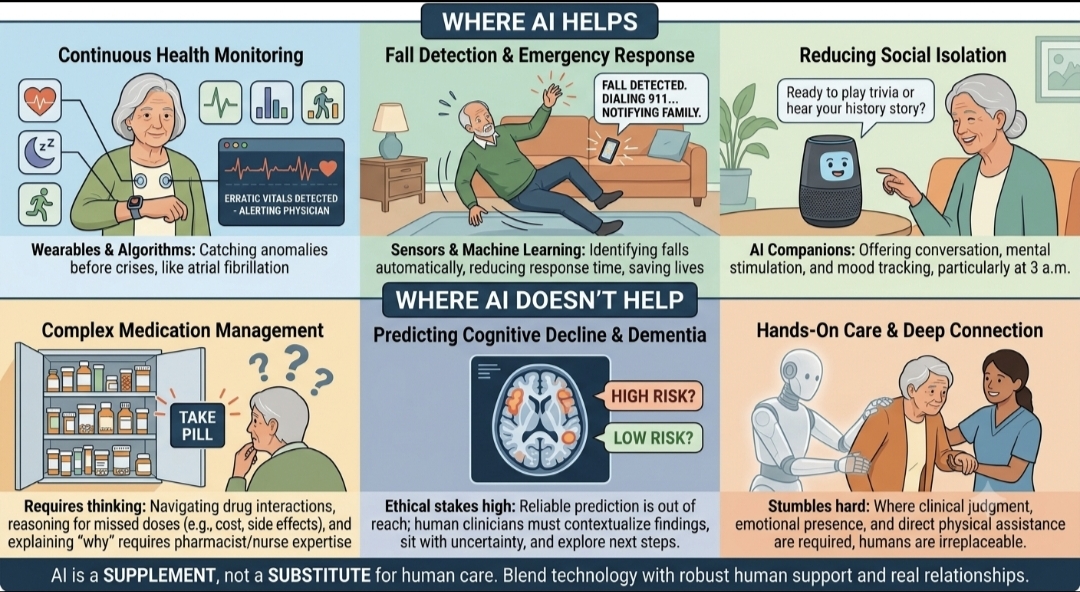
This is AI’s home turf. Wearables running AI algorithms track heart rate, sleep quality, and activity levels around the clock — surfacing anomalies before they spiral into crises. An irregular heartbeat consistent with atrial fibrillation might trigger an alert days before anything serious happens. These systems chew through data faster than any human could. Subtle shifts in vital signs — the kind hinting at infection, cardiac trouble, or something else quietly brewing — get caught early.
For older adults living alone or juggling multiple chronic conditions, continuous oversight like that is genuinely valuable. The system doesn’t get tired. It doesn’t forget. Early detection can mean managing something at home rather than a hospital admission. That said? The whole setup collapses without proper configuration, consistent use, and healthcare providers who actually act on the alerts.
2. Where AI Falls Short: Medication Management and Adherence
AI can remind someone to take their pills. It can log what got taken. What it cannot do is think. Older adults frequently juggle several medications simultaneously, and the interaction risks buried in those combinations require real pharmacological expertise to navigate safely. A missed-dose alert tells you something was skipped — it won’t tell you whether taking it late is safe given the person’s current condition, their recent meals, or every other drug in the mix. That call requires someone who knows the full picture.
Adherence is messier than a checklist, too. People skip doses for reasons AI will never surface: embarrassing side effects, cost anxiety, depression that’s gone unmentioned. A pharmacist or nurse can dig into those underlying issues and actually problem-solve. An automated reminder just repeats itself — growing less effective every cycle. Explaining why a medication matters, validating concerns, resetting expectations — none of that fits inside a prompt.
3. Where AI Helps: Reducing Social Isolation Through Companionship Tools
Loneliness among older adults is a real health risk. Not a soft one. AI chatbots and conversational systems have stepped in as a partial answer, particularly for people with limited mobility or infrequent family contact. These tools hold a conversation, answer questions, prompt memory with upcoming events, offer mental stimulation through games or trivia. For someone homebound with few daily visitors, that’s multiple meaningful touchpoints in an otherwise quiet day. Some systems even watch for shifts in mood or communication patterns that could signal depression or early cognitive changes.
Accessibility and consistency are the selling points. Available at 3 a.m. Never tired of the same story told for the fourth time. Tunable to specific interests — someone passionate about history could interact with a system built around exactly that. But there’s a ceiling. Families weighing care options for older adults who need daily support alongside genuine human connection often find that assisted living in Prescott Valley, AZ delivers the structured human presence and professional oversight no AI companion can replicate. Real relationships — reciprocal, caring ones — are what older adults need. AI patches gaps in availability. It never fills that deeper need.
4. Where AI Struggles: Predicting Cognitive Decline and Dementia
AI trained on brain imaging, genetic data, and cognitive assessments can spot patterns linked to decline. That part holds up. But reliable prediction — who will develop dementia, and when — remains out of reach. Two people with nearly identical imaging results and test scores can follow completely different trajectories. Lifestyle, education, environmental exposure, motivation: these shape outcomes in ways current AI systems don’t fully capture.
The ethical stakes are high. An algorithm flagging elevated dementia risk might trigger severe anxiety or push families toward interventions that aren’t yet warranted. A low-risk result might offer false reassurance. A human clinician can do something AI simply cannot — contextualize findings honestly, sit with uncertainty alongside the patient, and explore what steps make sense regardless of what any prediction says. The distance between pattern recognition and genuine clinical understanding is still wide. Treating algorithmic output as a primary decision-making tool here is premature. And it can genuinely hurt people.
5. Where AI Helps: Fall Detection and Emergency Response
Fall detection is one of AI’s clearest wins. Wearables and environmental sensors identify a fall and automatically alert emergency services or family — cutting response time in situations that can turn fatal. Machine learning distinguishes real falls from ordinary movement, reducing false alarms that make simpler systems frustrating and eventually ignored. For someone living alone, automatic detection means help arrives in minutes. Not hours. That gap matters enormously.
The technology’s strength is that it doesn’t depend on the user doing anything. No button. No code to remember. It just works. But detection isn’t prevention. Lighting improvements, removing trip hazards, strength training — those still matter. Physical therapy, vision correction, medication review: human-led interventions that address why falls happen in the first place. AI handles the emergency response. The root causes? Those require human hands.
Conclusion
AI is a legitimate tool for specific aging challenges. Continuous monitoring, fall detection, companionship availability — these applications play to its actual strengths: processing data without fatigue, staying consistent, showing up at any hour. But the limits surface fast wherever clinical judgment, behavioral insight, emotional support, or physical care enters the picture.
Medication complexity, dementia risk, genuine human connection — technology doesn’t replace what’s needed there. Effective aging care blends AI tools where they truly contribute with robust human support, professional oversight, and real relationships. Think of AI as a supplement. Useful, in the right places. Never a substitute for the human presence that remains, stubbornly and essentially, irreplaceable.