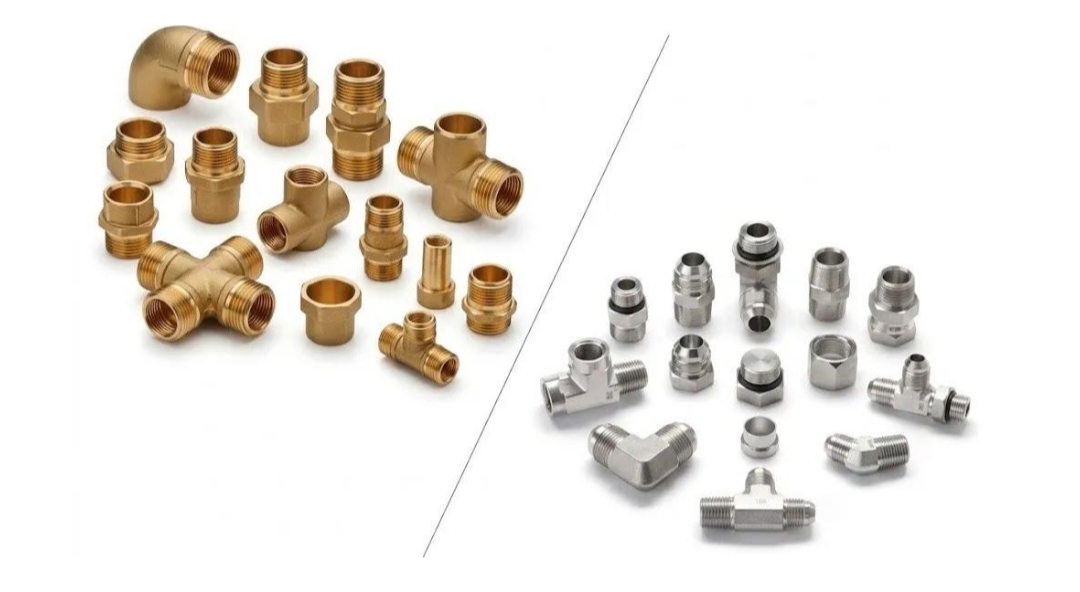
Brass and stainless steel are both widely used for fitting applications. Stainless steel and brass fittings manufacturers both make common fitting geometries. For example, elbows and tees are common in both types of fittings, but which is better for your application?
In this article, we cover where brass fittings perform better, where stainless steel fittings work very well, and how to select between them.
Where Brass Fittings Work Well
Brass fittings can make more sense than stainless steel fittings in applications where machinability, cost, conductivity, and general-purpose fluid compatibility are important.
Suitable for Water and General-Purpose Fluid Service
Brass fittings are widely used in water-related and other fluid applications. Brass can work well in water and general-purpose fluid applications.
Several brass grades meet lead-free, potable-water, or DZR requirements. These can work in suitable water-related applications. C69300 is a dezincification-resistant brass grade in the USA, while CW724R and CW511L are DZR brass grades used for EU applications.
Good Machinability
Brass provides good machinability, which is important when producing fittings in bulk. This is one of the main advantages of certain brass alloys.
Brass C36000 provides excellent machinability. Some stainless steel grades can be harder to machine, which can increase machining time and production costs.
Cost Considerations
Brass can make sense when the application does not require the higher corrosion resistance, strength, or temperature capability offered by a suitable stainless steel grade.
Electrical and Thermal Conductivity
Brass has useful electrical and thermal conductivity, which can matter in applications where these properties have a functional role.
Overall, brass works well when the environment does not demand the higher corrosion resistance, strength, or temperature performance available from a suitable stainless steel grade.
Where Stainless Steel Is the Better Choice
Stainless steel includes a broad range of grades with different corrosion resistance and mechanical properties. A suitable stainless steel grade can be selected when an application requires higher corrosion resistance, strength, or temperature performance.
Corrosive Fluids and Chemical Environments
Some stainless steel grades provide greater corrosion resistance than brass. However, the stainless steel grade still needs to match the fluid and service conditions.
Molybdenum-containing stainless steel grades can provide better resistance to pitting and crevice corrosion, particularly in chloride-containing environments. Stainless steel fittings are commonly used in chemical processing, offshore process panels, and chemical injection systems.
SS 316 generally provides better resistance to pitting and crevice corrosion than SS 304 in many chloride environments.
Chloride Exposure
Chloride exposure requires particular attention when selecting stainless steel fittings. Chlorides can cause pitting and crevice corrosion, and certain conditions can also lead to chloride stress-corrosion cracking.
SS 316 generally offers better resistance to chloride pitting than SS 304. However, stainless steel is not completely immune to chloride corrosion, so the grade and service conditions must be evaluated carefully.
Higher Strength and Temperature Requirements
If an application requires higher-strength fittings, some stainless steel grades can provide an advantage over certain brass grades.
Some stainless steels also provide higher mechanical performance at elevated temperatures. For example, 316H has higher strength at elevated temperatures and can be suitable for certain high-temperature applications.
Stainless steel can therefore become a suitable choice when an application requires a higher level of corrosion resistance, strength, or temperature performance.
How to Select Between Brass and Stainless Steel Fittings
The selection between brass and stainless steel should be based on the actual application requirements and service conditions.
Before selecting a fitting material, consider the following factors.
Fluid Compatibility
The first factor to consider is what passes through the fittings. Water, oil, gas, and chemicals can affect material selection.
Make sure the selected material and grade are compatible with the fluid and the overall service conditions.
Operating Temperature
Next, check the application’s actual operating temperature. Temperature can affect material performance and pressure ratings.
Do not assume that one general temperature limit applies to all fittings. Each fitting has its own limitations, so check the temperature rating for the exact fitting and material being considered.
Working Pressure
The required working pressure is another important consideration. Each fitting must be capable of handling the system pressure at the applicable operating temperature.
Do not judge pressure capability based only on the raw material. Fitting size, connection design, material, and product specifications can all affect the actual pressure rating.
Corrosion Exposure
Consider both the environment surrounding the fittings and the fluid flowing through them.
Chlorides, seawater, aggressive water, and chemical exposure can all influence material selection. Certain stainless steel grades may provide better resistance in more aggressive environments.
Required Strength
Check the mechanical loads and strength requirements of the application.
Do not assume that every stainless steel grade will be stronger than every brass alloy. Duplex stainless steel such as 2205 can provide much higher mechanical strength than standard austenitic stainless steels and may suit applications involving heavy loads and corrosive service.
Material Specification
Finally, confirm the exact material required for the fitting.
“Brass” and “stainless steel” are not complete material specifications because each material group contains different alloys and grades. Check the required brass or stainless steel alloy, applicable material specification, and product requirements.
When these factors are considered together, the material selection becomes much clearer. Choose the material and grade that meet the actual fluid, temperature, pressure, corrosion, strength, and specification requirements rather than selecting a fitting based only on its material category.
Conclusion
There is no single material that is superior for every fitting application. Brass and stainless steel each have their own advantages and limitations.
Before selecting fittings, evaluate the fluid, operating temperature, pressure, corrosion exposure, required strength, and exact material specification. The right choice ultimately depends on the actual service conditions and the specific material grade required for the application.